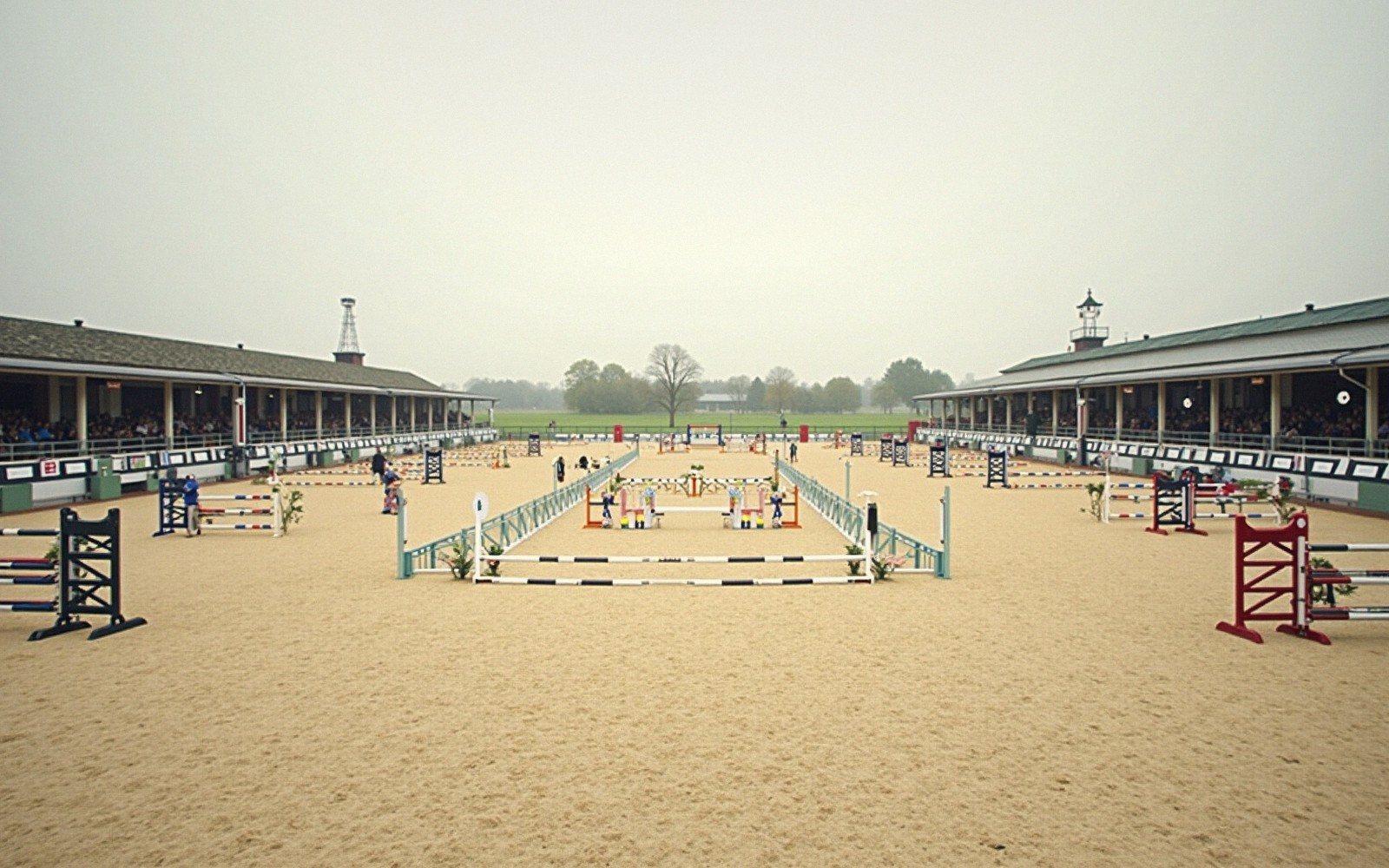
One horse, one track, a clock and a set of rules that reward accuracy over speed — until they don't.
A horse and rider enter an arena, follow a numbered course of obstacles, and try to finish without knocking anything down or refusing to jump. That is it. That is the whole sport.
Except, of course, it isn't. The apparent simplicity is what makes show jumping so watchable: the stakes are legible to anyone within thirty seconds. A rail falls — something went wrong. The buzzer sounds — time ran out. But underneath that immediate clarity lies a sport of considerable tactical depth, one that rewards technical precision at speed while constantly threatening to punish the smallest miscalculation with instant, irreversible consequence.
The apparent simplicity is what makes show jumping so watchable: the stakes are legible to anyone within thirty seconds.
No other major equestrian discipline offers that combinationCombinationTwo or three obstacles a strideStrideOne full canter step, roughly 3.5 m in a working competition canter. or two apart, numbered A, B and C. or two apart, numbered A, B and C. or two apart, numbered A, B and C. of obviousness and complexity. Dressage rewards invisible correctness. Cross-country punishes error with mud and momentum. Show jumping does something else: it makes the error public, loud and arithmetically exact.1
The Structure of a Round
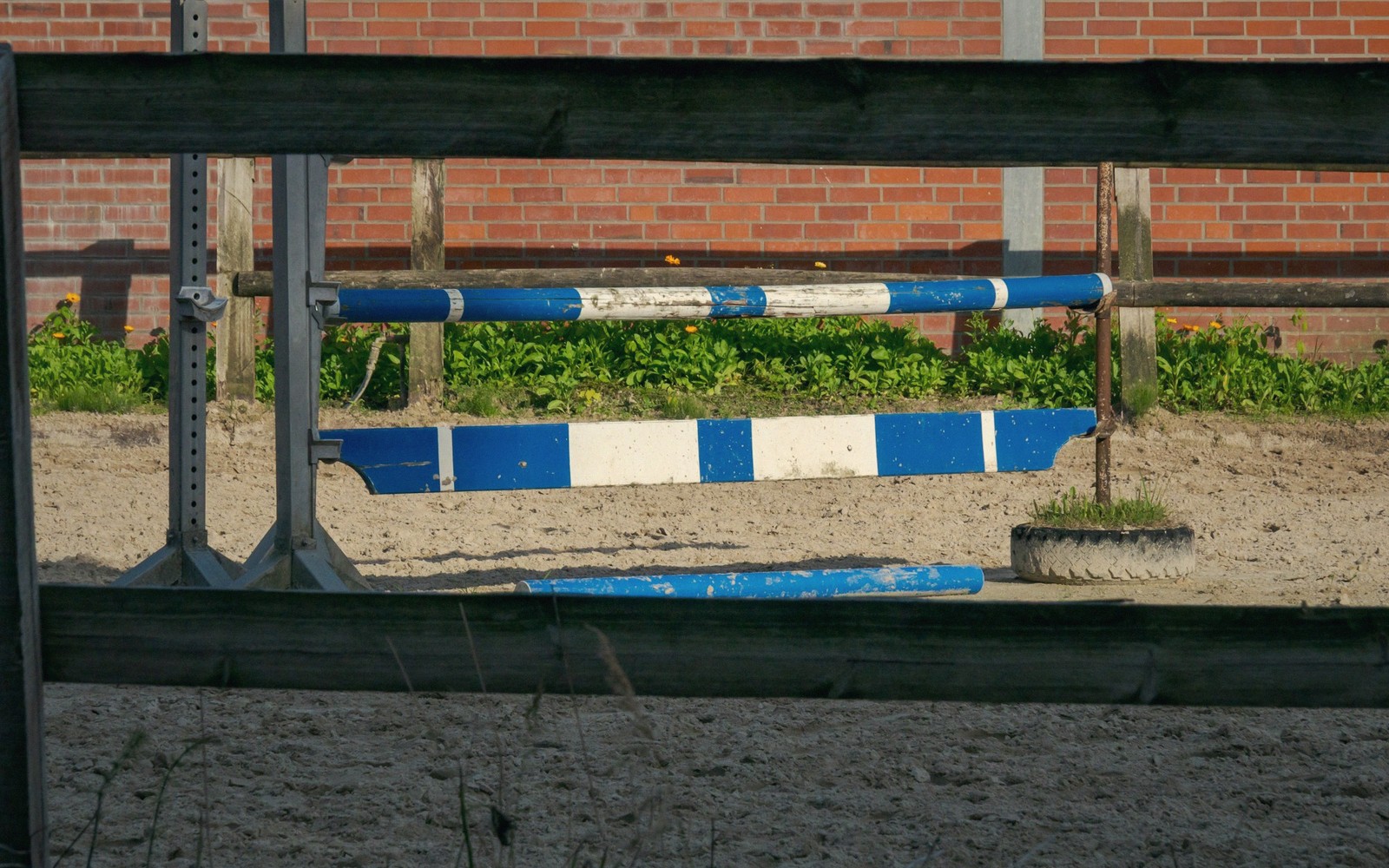
A course typically runs eight to thirteen fences, most of which can be jumped in any style — but only in the correct order. The obstacles themselves are designed to fall. Every pole is balanced on shallow cupsCupThe bracket holding a pole, shallow at the front so the rail rolls out. precisely so that a genuine touch sends it down rather than trapping the horse. Height at the top levels reaches around 1.60 metres; spreads on wide oxersOxerA spread fence with two sets of rails, asking for width as well as height. can push beyond two metres. At lower levels, the dimensions scale accordingly, but the format is identical.
The scoring system is built on faults. A rail down is four faults. A refusalRefusalhorse stops or runs out at a fence; four faults — the horse stopping or running out at a fence — is also four faults, and a second refusal in the round eliminates the pair entirely. Exceeding the time allowed costs one fault for every commenced second over the limit. A round without any faults is a clear round, and a clear round is the objective. When multiple combinations finish clear, the class does not simply declare co-winners: it goes to a jump-off.
The jump-off is a shorter course over a selection of the original fences, ridden against the clock. Here the logic flips. Accuracy still matters — a rail costs four faults just as before — but time now separates combinations with equal scores. The fastest clear round wins. Riders must therefore decide, fence by fence, how much risk they are willing to buy with speed. A tight inside turn saves half a second and risks a distance problem; a wide, safe approach costs time and may cost the class. That decision-making, compressed into ninety seconds of riding, is where most of the drama lives.2
Why It Works as a Sport
Show jumping functions as a spectator sport for a reason that has nothing to do with marketing: the outcome is always visible and always immediate. There is no scoring panel, no subjective assessment, no waiting for judges to deliberate. The scoreboard changes the moment a pole moves. Viewers who have never sat on a horse understand, within one fence, what they are watching.
The sport also scales. Local competitions and club shows use the same format, the same fence designs and the same fault system as the Olympic Games, adjusted only for height and technical complexity. This means that someone who has watched a grand prix class on television and then attends a local show will recognise everything they see. The vocabulary does not change.
And the vocabulary is worth learning, because once you know what a correct distance feels like to watch — a horse arriving at the base of a fence in a rhythm that requires no adjustment — you can see exactly when a combination is in trouble. You notice the chip, the long spot, the stride that gets added in the last moment. The sport stops being a blur of colour and noise and becomes a readable sequence of problems and solutions.
| Ref | What happened | Penalty |
|---|---|---|
| 2.1 | Obstacle knocked down | 4 faults |
| 2.2 | Foot in the water | 4 faults |
| 2.3 | First refusal or run-out | 4 faults |
| 2.4 | Second refusal in the round | Elimination |
| 2.5 | Exceeding the time allowed | 1 fault per second or part |
| 2.6 | Exceeding the time limit | Elimination |
| 2.7 | Fall of horse or rider | Elimination |
| 2.8 | Jumping an obstacle out of order | Elimination |
| 2.9 | Starting before the bell | Elimination |
Reference numbers are this guide’s own, for linking inside the site. They carry no official standing.
Where to Start
The best entry point is not the grandest class. Watch a smaller class first, where the fences are manageable and combinations are not moving quite so fast. Follow a single horse for its whole round. Notice where it is in balance, where the rider steadies, where the horse leans into the turn. By the time you get to the jump-off, you will already know enough to feel the decision being made between fences — the brief straightening of a line, the shortening of a stride, the moment a rider commits to the turn and the horse either finds the distance or it doesn't.
That moment — half a second, decided ten strides out — is the whole sport in miniature.
- Clear round
- a round completed with zero faults
- Fault
- penalty point; four for a rail or refusal, one per second over time
- Jump-off
- tiebreaking second round ridden against the clock
- Refusal
- horse stops or runs out at a fence; four faults
Every figure in this guide is indicative. Heights, spreads, speeds and distances vary between levels and federations, and the rules of the competition being run always govern.