Every rail, cupcupshallow bracket on an upright that holds a rail and releases it on contact and pin in a modern fence exists to fail safely — and that design principle changes everything about how the sport works.
Walk into any warm-up arena before a competition and the fences look, at first glance, remarkably flimsy. Rails wobble when touched. Cups are shallow. Nothing is bolted down. That fragility is not a shortcut or a cost-saving measure — it is the entire point. A show jump is engineered, from the ground up, to fall when a horse makes contact, and to do so without punishing the horse for the error.
The logic behind this begins with safety. A fixed fence — the kind found in cross-country — demands a horse jump clean because there is no mechanical forgiveness. A show jump offers a different contract: accuracy is rewarded with a clear round, but an imprecise jump produces a fallen rail and a four-fault penalty rather than a fall. The fence gives way so the horse does not have to.
A fixed fence — the kind found in cross-country — demands a horse jump clean because there is no mechanical forgiveness.
That single engineering principle — controlled failure — ripples through every component of the fence.1
What Actually Falls, and Why
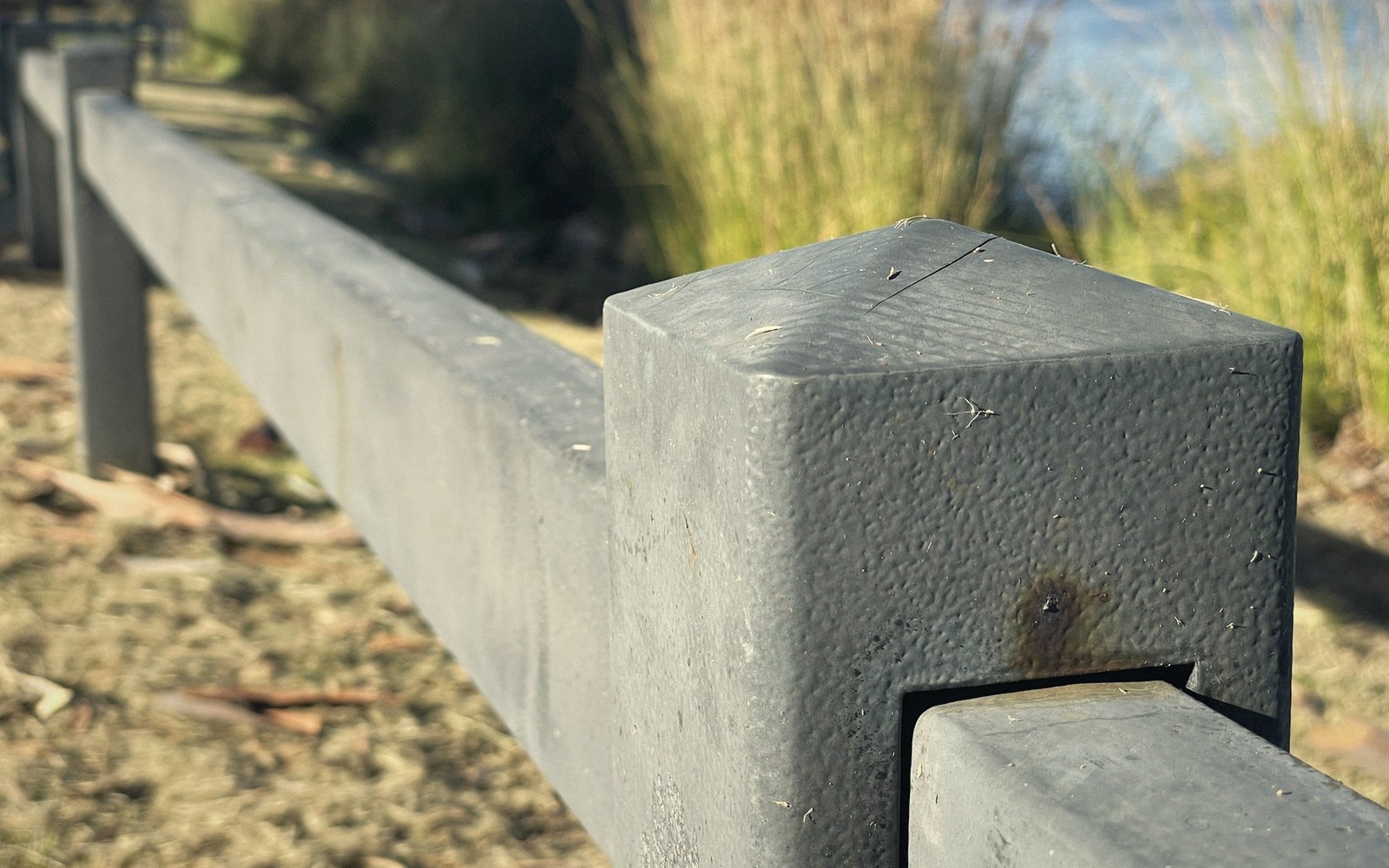
The horizontal rail is the key element, and it sits in a device called a cup: a shallow, C-shaped bracket mounted on the upright wing or standardstandardverticalVerticalA single plane of rails with no spread — a pure height and accuracy question. upright supporting the rail cups; weighted at base, not fixed to ground upright supporting the rail cups; weighted at base, not fixed to ground upright supporting the rail cups; weighted at base, not fixed to ground. The depth of that cup is the crucial variable. Deep cups grip the rail; shallow cups release it with minimal force. Championship courses typically use shallow cups throughout, so that the lightest touch — a hind leg barely grazing a back rail — is enough to unseat it. The rail then rolls or drops cleanly, neither catching on the horse's leg nor being flung into the arena.
The rails themselves are usually hollow aluminium or lightweight wood. Hollow aluminium, now the more common choice at senior competitions, is consistent in weight and does not splinter. A standard rail is roughly four metres long. Its weight matters: too light, and a breath of air from a jumping horse will rock it out of the cups; too heavy, and the cup has to grip harder to hold it in place, which reduces sensitivity. Manufacturers calibrate rail weight and cup depth against each other.
The standards — the vertical uprights — are weighted at the base for stability but not fixed to the ground. A horse that collides with a standard will knock it over rather than be stopped by it. Ground poles, laid flat at the base of a fence to help a horse judge its take-off, present no significant obstacle if a horse steps on them. Even the decorative fillers — planks, gates, false hedges, decorative panels — are designed to topple or flex. A wooden plank sits in its own shallow cups and falls as readily as any rail.
The hierarchy is deliberate: the supporting hardware releases the rail, not the other way around. The standard is weighted to stay up under a light touch, while the rail comes down. That distinction matters, because a standard rolling loose under a horse's feet is a hazard; a dropped rail, lying flat, is not.2
Four Faults, and the Whole System That Depends on It
The fallen rail is not simply a design feature in isolation — it is the foundation of the sport's scoring system. Because a rail can fall, a mistake has a precise, consistent consequence. Every dislodged rail costs four faults, regardless of how far it falls or which fence it came from. That uniformity is only possible because the fence is reliable: if some rails fell easily and others did not, the penalty would feel arbitrary. The engineering consistency is what makes the penalty consistent.
This is also why course designers think carefully about cup depth. A shallow cup on the back rail of an oxer rewards genuine scope; a deeper cup on a decorative filler prevents it from toppling in the wind between rounds. Designers adjust hardware to match the question the fence is asking, not simply to make the course harder or easier.
The result, across a full course of ten to thirteen fences, is a precisely calibrated system of measured errors. Every rail that stays up is a small mechanical confirmation of accuracy. Every rail that falls is the fence doing exactly what it was designed to do — giving way cleanly, recording the mistake, and leaving horse and rider to ride on.
| Ref | What happened | Penalty |
|---|---|---|
| 2.1 | Obstacle knocked down | 4 faults |
| 2.2 | Foot in the water | 4 faults |
| 2.3 | First refusal or run-out | 4 faults |
| 2.4 | Second refusal in the round | Elimination |
| 2.5 | Exceeding the time allowed | 1 fault per second or part |
| 2.6 | Exceeding the time limit | Elimination |
| 2.7 | Fall of horse or rider | Elimination |
| 2.8 | Jumping an obstacle out of order | Elimination |
| 2.9 | Starting before the bell | Elimination |
Reference numbers are this guide’s own, for linking inside the site. They carry no official standing.
- cup
- shallow bracket on an upright that holds a rail and releases it on contact
- standard
- vertical upright supporting the rail cups; weighted at base, not fixed to ground
- filler
- decorative panel (plank, gate, hedge shape) placed under or between rails
- ground pole
- horizontal pole laid flat at fence base to assist take-off sighting
Every figure in this guide is indicative. Heights, spreads, speeds and distances vary between levels and federations, and the rules of the competition being run always govern.