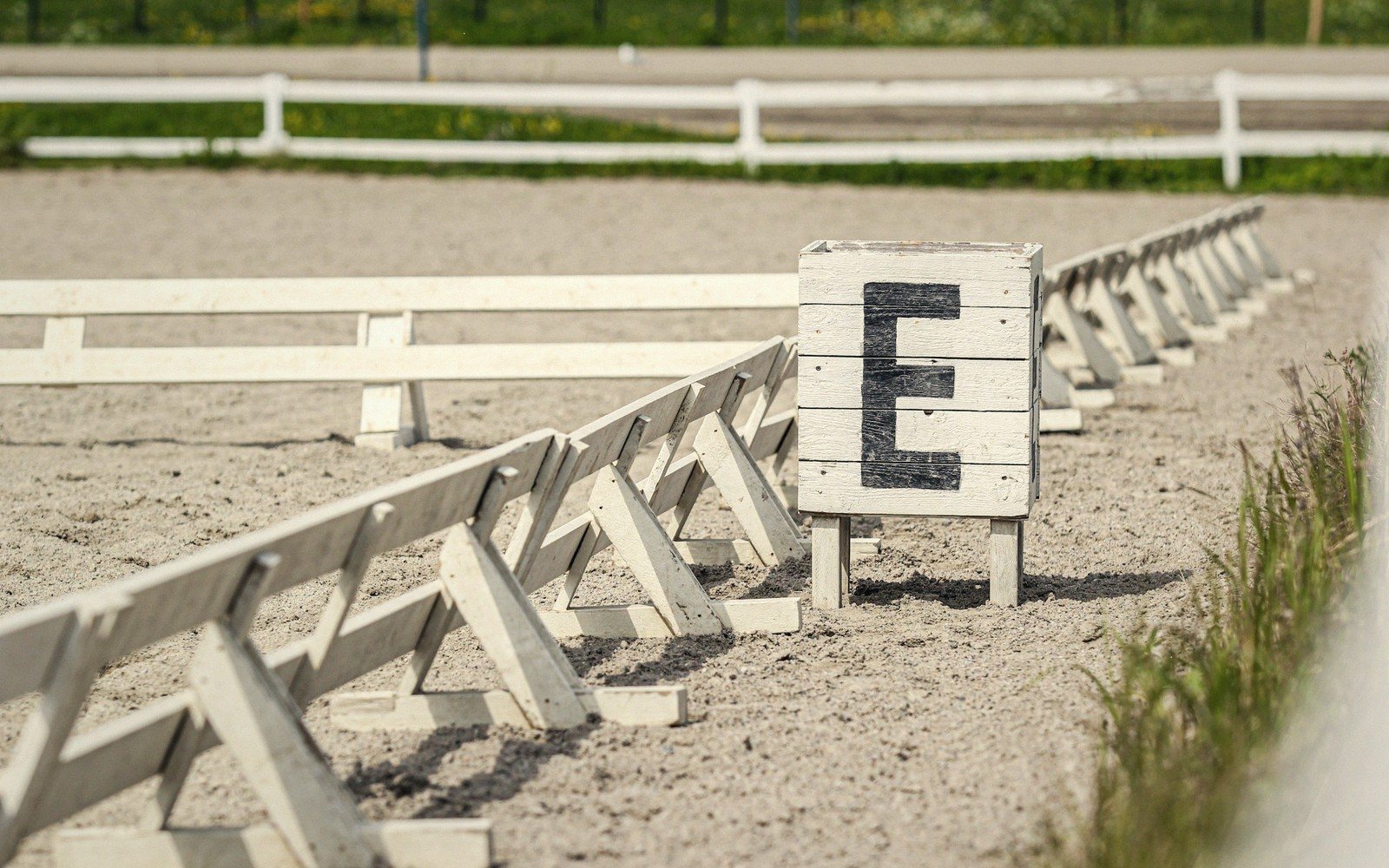
The clock is always running. Most riders never come close to it — until the moment they do.
Every show jumping class carries a time allowedTime allowedThe target time for the round, derived from course length and the class speed.: a figure calculated from the course's length and the speed the designer has assigned to the round. The formula is straightforward — divide the course length in metres by the speed in metres per minute, multiply by 60, and the result is how many seconds a horse and rider have to complete the track without penalty.
The speed itself is not arbitrary. It varies by level: lower-level classes typically use a slower prescribed speed, while international grand prix classes run faster — broadly in the range of 350 to 400 metres per minute for senior FEI competition, though the precise figure varies by class type and is set by the technical delegate for each event. Course designers measure the track along the path a horse is expected to travel, walking a realistic line through each turn, not a straight-line approximation. That path length, divided by the assigned speed, produces the time allowed posted at the in-gate.
That path length, divided by the assigned speed, produces the time allowed posted at the in-gate.
What the number punishes is not slowness in any absolute sense. A horse cantering at a normal working pace covers ground far faster than the time allowed demands. The threshold is generous enough that a smooth, forward round almost never touches it. What eats into that buffer is everything else: a wide approach that adds ten metres, a steadying strideStrideOne full canter step, roughly 3.5 m in a working competition canter. before a difficult combinationCombinationTwo or three obstacles a stride or two apart, numbered A, B and C., a broken canter that loses rhythm and ground in a corner. Time faults accumulate at a rate of one fault per second — or part thereof — over the limit. There is no grace.1
Why It Bites When It Does
The mechanism matters. A rider who finishes three and a half seconds over time collects four time faults, because every commenced second counts. That transforms a near-miss into a meaningful penalty — one that can drop a seemingly clear roundClear roundA round completed with no jumping faults and inside the time allowed. from first place to outside the ribbons.
For most of a class, the time allowed is background noise. Riders in a grand prix are not thinking about the clock the way a sprinter thinks about a stopwatch; they are thinking about the horse's stride, the line to the next fence, the question the designer has set. A forward, rhythmic ride handles the time almost automatically. The clock only becomes audible — metaphorically — when something interrupts that rhythm.
The most common trigger is a refusal. A stop at a fence costs four faults under the scoring system, and the rulebook allows the horse to be represented, but re-approaching a fence adds distance and lost seconds that quickly chew through the buffer. A rider who was comfortably inside the time suddenly finds themselves racing the clock for the remaining half of the course.
Spookiness produces the same effect more quietly. A horse that chips in an extra stride, drifts wide on a turn, or loses impulsion at a water tray is not visibly in trouble — but those fractions accumulate. In a long course with a tight time, a pattern of hesitations rather than one dramatic moment can end a round in time faults that were never foreseeable from the stands.2
The Designer's Instrument
Course designers are well aware of the clock's power, and they use it deliberately. A course with generous distances and wide turns will almost never catch anyone on time; the question is purely about rails. Tighten the turns, add a combination that requires a sharp rebalancing, or include a long galloping stretch that costs time to negotiate carefully, and the time allowed becomes a genuine second layer of difficulty — one that punishes a cautious, defensive style even if the fences stay up.
At the highest levels, when classes regularly produce large clear-round fields, time faults applied across the board can separate competitors without needing a jump-off. More often, the threat of the clock simply shapes how boldly riders commit to their lines. A rider who knows the time is tight cannot afford to check before every fence; they must trust the horse's engine and commit to the turn. That tension — between caution at the fence and urgency between them — is part of what makes the sport worth watching, and part of what the time allowed was always designed to create.
The course designer
Licensed official
Plans the track before anyone rides it: fence types, distances, angles and the time allowed. Oversees the build and adjusts for ground and light.
A role on every show, described here without naming individuals.
The fence crew
Arena team
Resets rails between rounds, checks cups and safety devices, and keeps every round on the same track as the one before it.
Role, not a named person.
Every figure in this guide is indicative. Heights, spreads, speeds and distances vary between levels and federations, and the rules of the competition being run always govern.