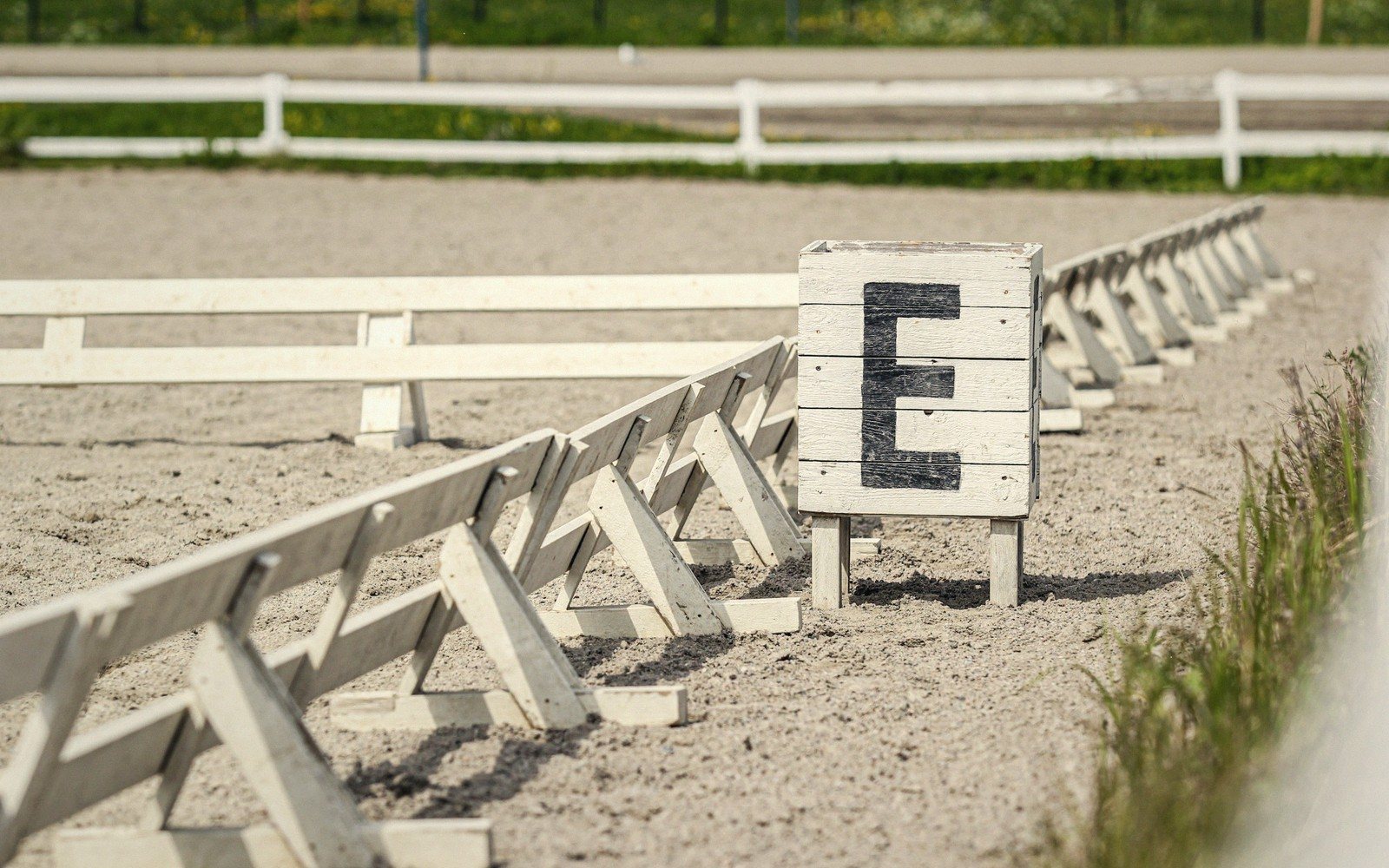
Every round in show jumping follows the same fixed sequence. Miss a step and you're eliminated — not just penalised.
The round begins with a signal — usually a bell or a horn — from the judge's booth. From that moment the rider has a set number of seconds, typically around forty-five, to cross the start line. Cross too late and the clock keeps running; fail to start at all and you're eliminated. The start line is marked by two electronic timing posts, sometimes called photocells, set just inside the arena entrance or at a designated point on the track. Breaking the beam starts the clock.
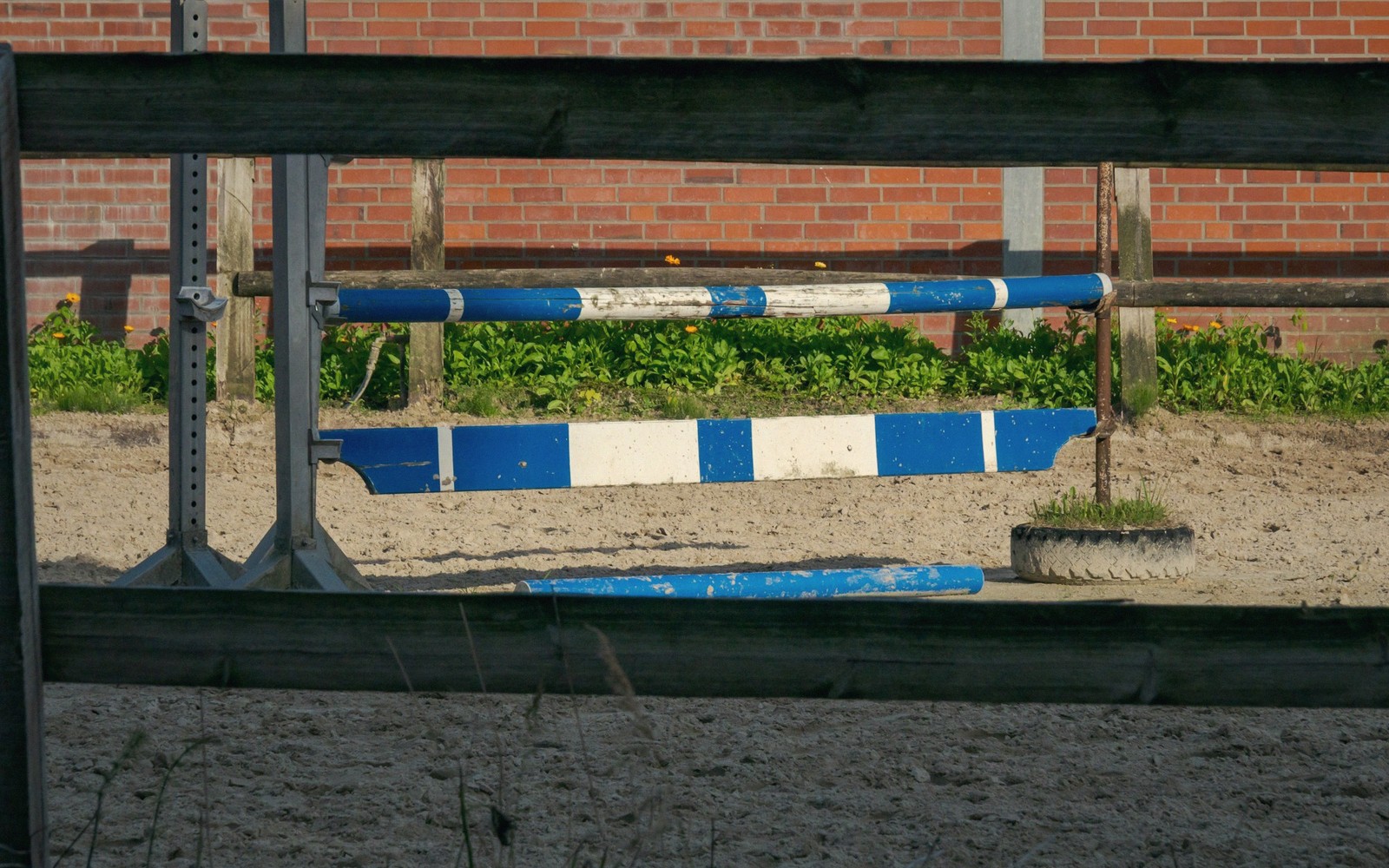
The course then runs in a fixed numbered sequence. Fences are flagged red on the right and white on the left; the rider must pass each fence with red to the right. Jumping fences out of order, approaching from the wrong direction, or skipping one entirely — all result in elimination, not extra faults. The fence types along a track vary deliberately: verticalsVerticalA single plane of rails with no spread — a pure height and accuracy question., oxersOxerA spread fence with two sets of rails, asking for width as well as height., combinationsCombinationTwo or three obstacles a strideStrideOne full canter step, roughly 3.5 m in a working competition canter. or two apart, numbered A, B and C. or two apart, numbered A, B and C. or two apart, numbered A, B and C. — each posing a different question.
Jumping fences out of order, approaching from the wrong direction, or skipping one entirely — all result in elimination, not extra faults.
A combination fence — two or three elements lettered A, B and sometimes C — counts as a single numbered obstacle but demands multiple efforts in close succession. A knockdown at element B still costs four faults; a stop at B costs four faults and must be re-jumped from A. That re-jumping of earlier elements is one of the few cases where a fence is jumped outside the forward sequence yet entirely within the rules.
The round ends the moment the horse and rider cross the finish line — again a photocell beam. Critically, the clock stops at the finish regardless of what has just happened: a rail can fall after the horse has jumped the last fence but before it reaches the beam and it still counts; once the horse has passed through the beam, nothing counts, but the time is already frozen. Riders sometimes ease up fractionally once through the beam; coaches sometimes wish they wouldn't.
After the finish, there is a third kind of line that matters: the curb or boundary of the arena. The rider must not leave the arena before the judge signals the end of the round. In high-level competition, the signal comes quickly; in a busy national class, there can be a pause while judges confirm the score. The experienced rider halts, settles the horse and waits — unhurried, because the round is already decided and nothing changes it.
Bell. Start line. Numbered fences in sequence, red right. Finish beam. That's the architecture every round is built on, at every level from a local class to the Olympic Games.1
| Ref | What happened | Penalty |
|---|---|---|
| 2.1 | Obstacle knocked down | 4 faults |
| 2.2 | Foot in the water | 4 faults |
| 2.3 | First refusal or run-out | 4 faults |
| 2.4 | Second refusal in the round | Elimination |
| 2.5 | Exceeding the time allowed | 1 fault per second or part |
| 2.6 | Exceeding the time limit | Elimination |
| 2.7 | Fall of horse or rider | Elimination |
| 2.8 | Jumping an obstacle out of order | Elimination |
| 2.9 | Starting before the bell | Elimination |
Reference numbers are this guide’s own, for linking inside the site. They carry no official standing.
Every figure in this guide is indicative. Heights, spreads, speeds and distances vary between levels and federations, and the rules of the competition being run always govern.
- The bell is an instruction, not a suggestion — the clock follows it. ↩
- Combination elements are numbered A, B and C, and judged separately.