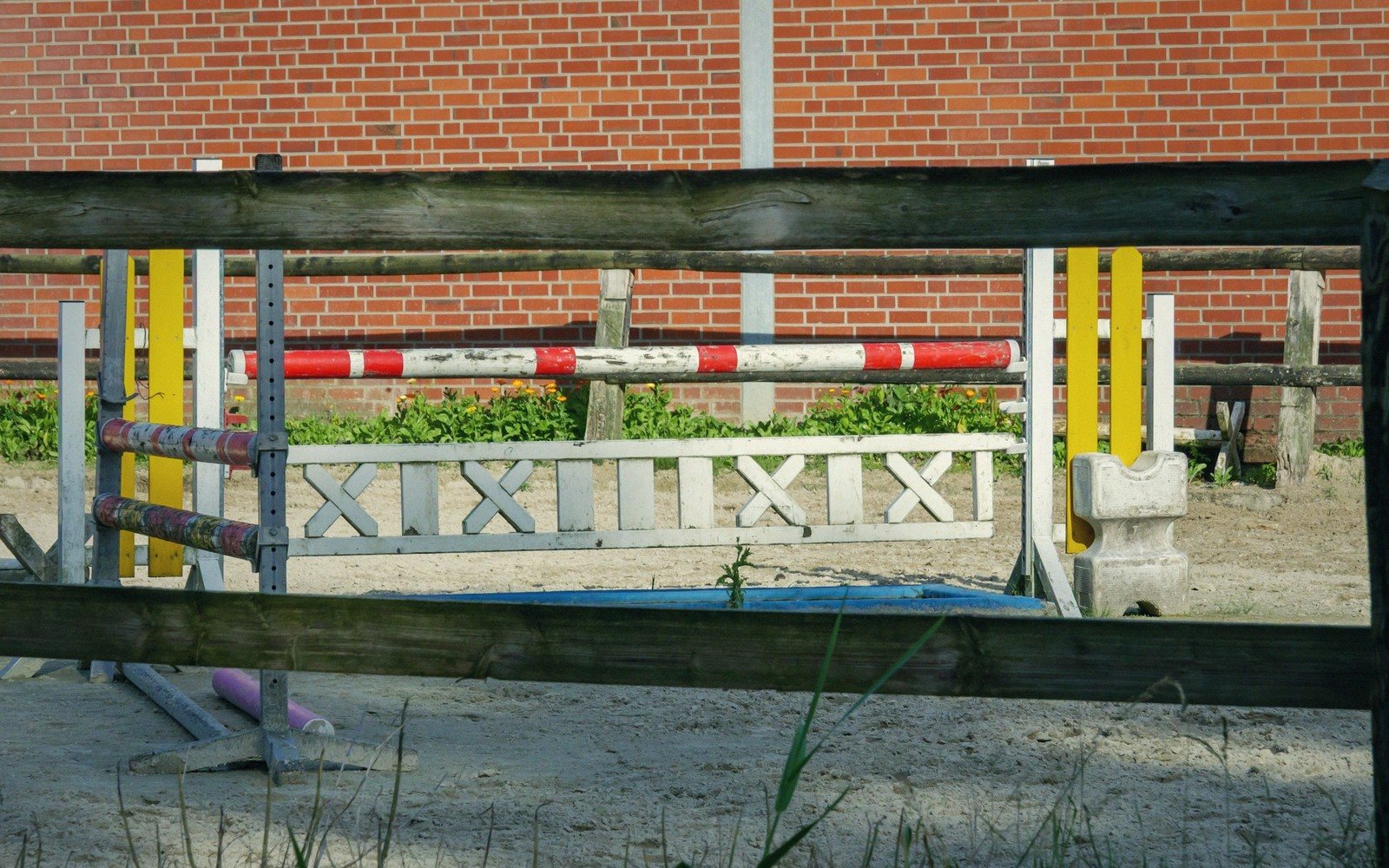
Every fence on a course asks a different question. Learning to tell them apart from the stands is the first step to understanding why some rounds unravel where they do.
Show jumping fences come in two fundamental families: those that challenge height alone, and those that challenge width as well. Every fence you see on a course — however decorated, however dramatic — belongs to one of these families, or combines them in a predictable way. Get that distinction in your eye and the track begins to make sense.
The simplest member of the height-only family is the vertical, or upright. A vertical is exactly what the name says: rails, a gate, a wall, or some combinationCombinationTwo or three obstacles a strideStrideOne full canter step, roughly 3.5 m in a working competition canter. or two apart, numbered A, B and C. or two apart, numbered A, B and C. or two apart, numbered A, B and C., all stacked in a single vertical plane. There is no spread. The horse must clear one line, and the question is purely about jumping cleanly up and back down in a tight arc. From the stands, a vertical looks flat-on — you see a face of poles or a solid-looking panel, with no depth beyond it. At the top levels, verticals can sit at 1.60 m or beyond, and the rail perched on those cupsCupThe bracket holding a pole, shallow at the front so the rail rolls out. has almost no margin for error.
At the top levels, verticals can sit at 1.60 m or beyond, and the rail perched on those cups has almost no margin for error.
What makes a vertical technically demanding is its back rail. Because everything is in one plane, a horse that flattens its arc even slightly — drifting forward through the jump rather than folding cleanly up and over — will catch the top pole on the way down. The approach pace matters enormously: too fast and the horse arrives under the fence with no time to lift; too slow and it lacks the impulsion to clear the height. A vertical rewards a rider who can bring the horse to a precise spot in front of the fence, which is why these fences so often follow a related distanceRelated distanceTwo fences close enough that the strides between them are counted. that has compressed or lengthened the stride.
The oxer introduces width. Where a vertical has one plane, an oxer has two — a front rail and a back rail — with a gap between them that the horse must span in a single arc. This spread dimension changes everything about what the fence asks. A wide oxer rewards a horse that has real scope: the ability to stretch out horizontally even while jumping to a significant height. From the spectator's viewpoint, the oxer is easily spotted by that visible depth — you can see through or over the fence to a second set of standards behind the first.
Oxers come in two main varieties. A square oxer (sometimes called a parallel) has its front and back rails at the same height: a true rectangle of air that must be cleared cleanly on both sides. This is the more demanding form, because there is no sloping profile to guide the horse's eye and no descending back rail to give the hind legs a little extra room. An ascending oxer, by contrast, has the back rail set higher than the front — the fence climbs away from the horse as it jumps. This shape is naturally more inviting: the horse can see the back rail above the front and instinctively knows where the top of the obstacle is. At any level of the sport you will see far more ascending oxers than true parallels, though parallels appear more frequently as the level rises because they demand greater scope and accuracy.
A third oxer variation, rarer but striking, is the Swedish oxer, in which the two rails cross each other in a visual X when viewed head-on — one rail angled up from left to right, the other from right to left. The Swedish oxer creates an unusual optical puzzle for the horse, making it harder to identify a single clean take-off point. Riders tend to approach with extra care; for spectators it is one of the most immediately recognisable fence shapes on the course.1
| Vertical | Oxer | Triple bar | |
|---|---|---|---|
| Shape | All elements in a single vertical plane. | Front and back rails, set apart. | Three rails, each set higher than the last. |
| Spread | None. | Height and width together. | The widest common obstacle. |
| What it asks | A pure height and accuracy question. | Width as well as height. | Genuine forward gallop into an ascending profile. |
The three shapes every course is written from. Everything else is a variation on them.
Adding the Third Element: Combinations and Triple Bars
The triple bar is an oxer with three elements rather than two, each rail set progressively higher than the last, creating a strong ascending staircase profile. The spread can be considerable — at Grand Prix level, a triple bar can stretch close to two metres wide — and because the profile climbs away so visibly, the horse is asked to jump in a long, low bascule rather than the tight arc demanded by a vertical. Triple bars often produce the boldest, most eye-catching jumps in a round precisely because the horse must really open up across them. From the stands, you will spot a triple bar immediately: three sets of standards in a row, each a step up from the last, the whole thing resembling a ramp.
The term combination describes something different: not a single fence shape but two or three fences placed so close together that the horse lands and takes off again within one or two strides. These are designated on the scoreboard and the course plan as a combination — typically called a double (two fences) or triple combination (three fences). Each element within a combination is judged separately: a horse that knocks the second rail of a double accumulates four faults even if the first element was clean, but knocking both elements means eight faults, not four. The compressed distances inside a combination — usually designed to ride in one or two strides — leave the horse almost no time to rebalance, which is why combinations are the places most likely to unravel a round.
Within a combination, each individual element may itself be a vertical or an oxer, and the sequence of shapes matters. A double built as vertical-to-oxer is a classic test: the vertical demands precision, the landing sets the horse up with impulsion already gathered, and the oxer rewards the forward stride. Reverse the order — oxer-to-vertical — and the task becomes harder. Landing off a wide oxer, the horse is naturally opening its stride; the vertical then demands an abrupt compression. This kind of puzzle is exactly the sort of question a course designer builds deliberately into a track.2
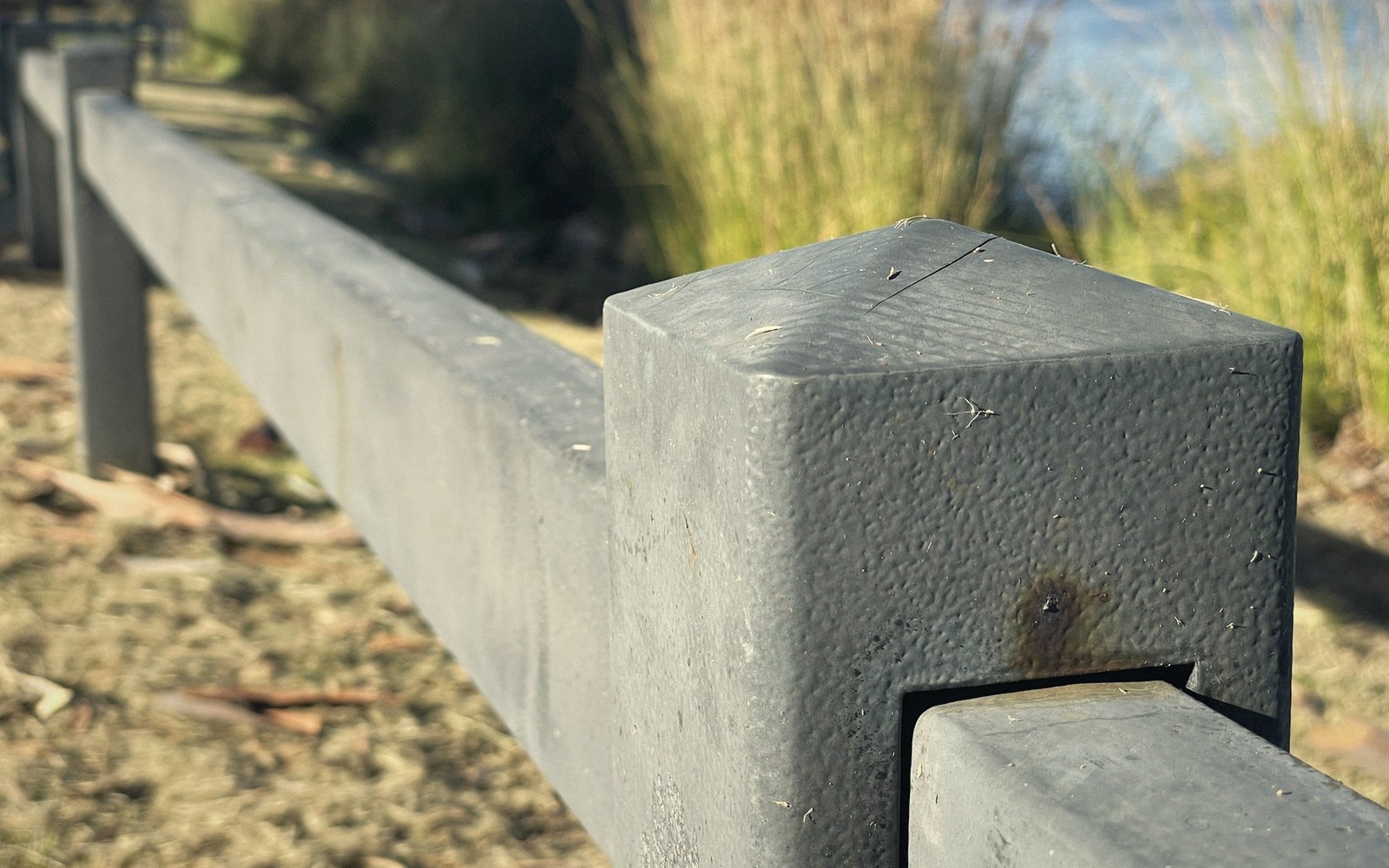

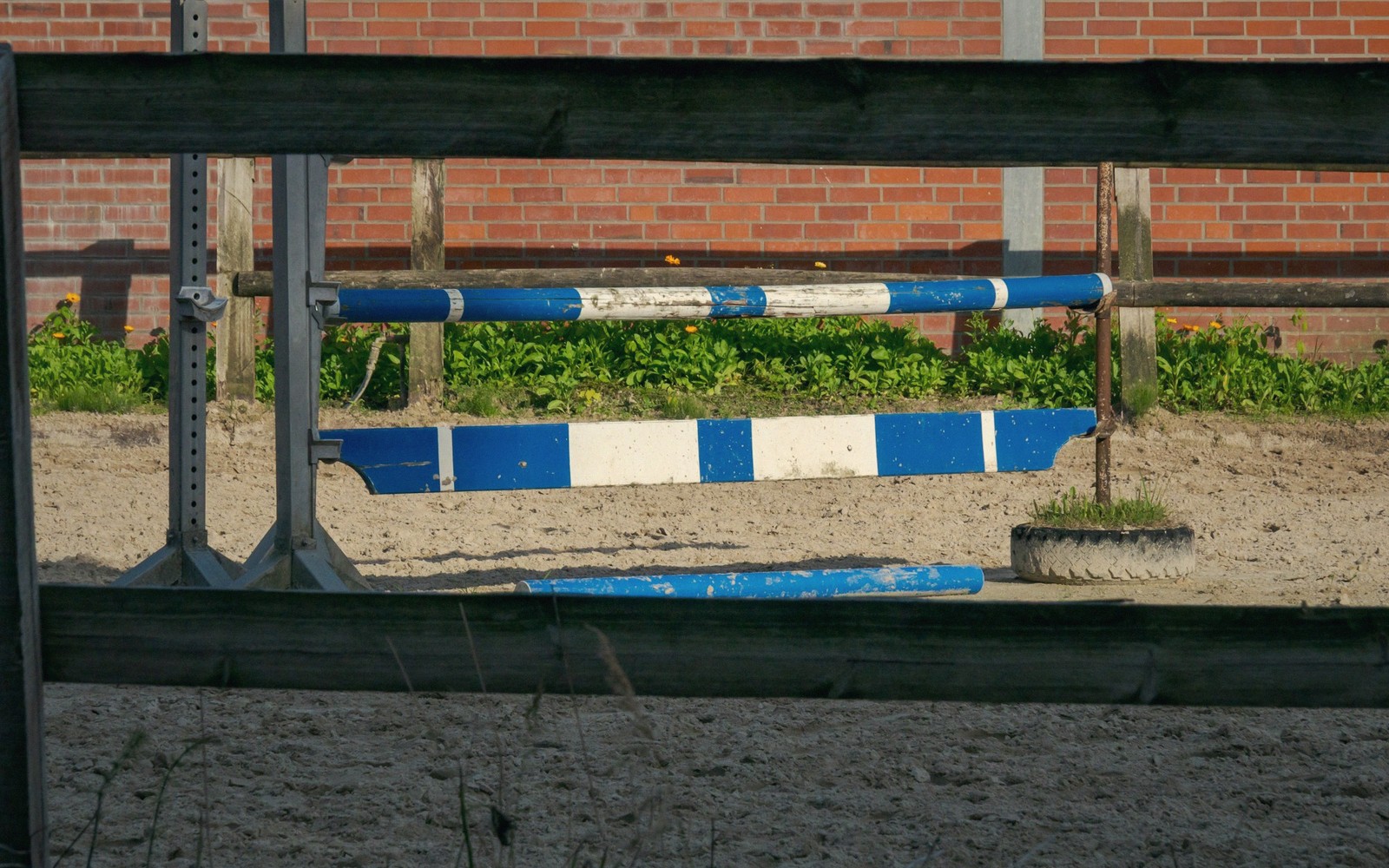
Fences, plans and tack — the furniture of the sport, photographed without riders.
Reading the Course from the Rail
For a spectator learning to read a round, the practical skill is simply naming the fence before the horse arrives at it. Vertical: one plane, flat profile. Oxer: two planes, visible depth, front and back rail. Triple bar: three planes, clearly ascending. Combination: multiple fences in a sequence, close enough that the horse cannot canter freely between them.
Beyond the shape, notice the decorating. Fences at the top of the sport are dressed elaborately — brush fillers, flower boxes, rustic gates, decorative walls — but the decoration rarely changes the fundamental question the fence is asking. A show jump is built to fall down: the decorated face may look solid, but the poles sitting in their cups are the real test. The visual weight of a big, elaborate vertical can unsettle a horse; a wide, colourful oxer can draw the eye in ways a plain parallel does not. Course designers choose decoration deliberately, and what looks merely theatrical from the stands is often a calculated part of the question.
What changes most across competition levels is not the vocabulary of fence shapes — verticals, oxers, triple bars and combinations appear at every height — but the degree to which each shape is pushed to its limit. A 1.20 m ascending oxer is a generous, flowing question; the same fence shape set at 1.60 m with a true parallel top is something the world's best horses and riders find genuinely hard. Once you can name the fence in front of you, you have the foundation to start understanding why some jump it cleanly and some do not.
- vertical
- a fence with all elements in one vertical plane; no spread
- oxer
- a fence with front and back rails, creating a spread dimension
- square oxer / parallel
- an oxer with front and back rails at equal height
- ascending oxer
- an oxer with the back rail set higher than the front
Every figure in this guide is indicative. Heights, spreads, speeds and distances vary between levels and federations, and the rules of the competition being run always govern.