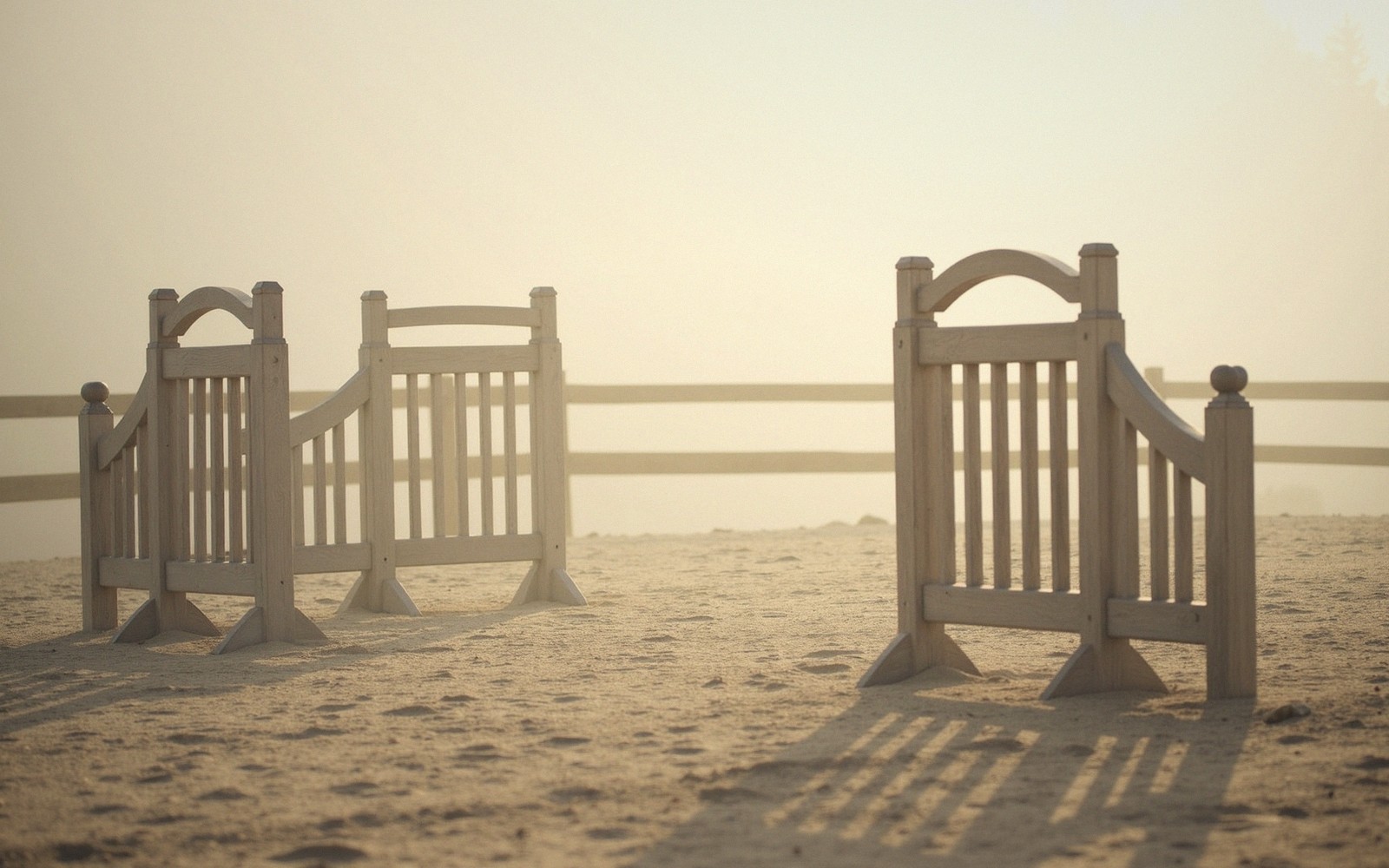
The ground between two fences does more work than the fences themselves — and a single strideStrideOne full canter step, roughly 3.6 m in a working competition canter. out of rhythm can unravel an otherwise clean round.
A related distancerelated distanceground between two fences coverable in a predictable number of strides is any stretch of track between two fences that a horse will cover in a predictable number of strides — typically two to five. Beyond that, the gap is long enough that a good rider can adjust freely; below it, the two obstacles are properly combined and governed by their own stricter rules. In the related-distance range, the fences are neither fully linked nor fully independent. That in-between quality is precisely what makes the ground between them the designer's sharpest instrument.
The standard reference point for course designers is the horse's working canter strideworking canter stridea horse's standard canter stride length, roughly 3.6 m, used as a planning unit: roughly 3.6 metres (about 12 feet) on level ground. Add a landing distance after the first fence and a take-off distance before the second — together those buffer zones account for approximately 6 metres — and a tidy related distance to a single intervening stride would run around 9–10 metres. For two strides, roughly 13–14 metres; for three, add another 3.6, and so on. These figures are indicative starting points, not fixed rules. Class height, terrain, fence type and the intended level of difficulty all pull the designer away from the textbook number.1
Class height, terrain, fence type and the intended level of difficulty all pull the designer away from the textbook number.
The Geometry of Pressure
Here is what spectators rarely appreciate: a related distance does not need to be dramatically wrong to be genuinely testing. A line measured two or three metres shorter than the comfortable norm asks the horse to shorten, compress and still generate enough power to clear the second fence. A line measured long asks it to lengthen, stay balanced and not flatten across the top. Either adjustment is manageable in isolation. String two or three related lines together in a sequence — as the better course designers regularly do at the upper levels — and the cumulative demand becomes something else entirely. A horse that chipschipan extra short stride inserted just before a fence, disrupting rhythm and take-off in an extra half-stride on the first line arrives marginally deep to the second fence; it clears that fence but drifts slightly right; the angle to the third line is now subtly wrong; and a fault that looks like a careless mistake at fence nine was actually made at fence four.
That is the designer's trap, and it is set deliberately. The objective is not to produce a fence that horses obviously cannot jump. It is to produce a track where errors propagate — where a single imprecision early in the course costs a rider not one fence but several.
The direction of travel matters as much as the distance itself. A related distance ridden away from the collecting ring, toward a dark corner of the arena or into a fence that looms against a bright backdrop, will ride longer than the tape measure suggests — horses tend to shorten instinctively. The same distance ridden toward the gate, downhill or toward a welcoming fence will ride shorter. Experienced designers account for this deliberately, sometimes using the optical effect of a fence's fill and colour to tighten or open a distance without touching the tape.2
Reading the Line from the Stands
From a spectator's position, the signature of a related distance going wrong is a horse visibly adjusting mid-line. Watch for the hesitation — a micro-pause where the rhythm breaks — or conversely, the sudden lengthening that tells you the rider has recognized a long distance and is pushing to meet it. If you see a rail fall at the second element of a related pair, the cause was often decided by how the horse left the ground at the first. A clean first fence, properly off the ground, gives the horse room to think; a fence jumped tight and upright — even one that stays up — leaves the horse with less scope and less time.
The most telling detail is what happens in the strides immediately after landing. A horse that lands in genuine balance, hind legs under its body, is already organizing itself for the next question. A horse that lands heavy on the forehand is spending those precious strides just recovering rather than measuring. Over a single fence that distinction might mean nothing. Over a sequence of related distances it is the difference between a clear roundClear roundA round completed with no jumping faults and inside the time allowed. and a faulted one.

Why the Distance Is Never Neutral
Show jumping's central fiction is that the obstacles are the challenge. They are not, or not primarily. The fences themselves are designed to be jumpable — that is the explicit engineering principle behind the sport's breakaway cups and lightweight poles. The real question is always the line between them: whether a horse can find its rhythm, maintain it under pressure and still arrive at each fence in a position from which it can jump cleanly. Related distances are where the designer encodes those questions most precisely, and where riders either solve them or don't.
A 14-metre two-stride line looks like a quiet corridor on the course plan. Walk it at height, in pace, when the round is on the line — and it is anything but.
- related distance
- ground between two fences coverable in a predictable number of strides
- working canter stride
- a horse's standard canter stride length, roughly 3.6 m, used as a planning unit
- chip
- an extra short stride inserted just before a fence, disrupting rhythm and take-off
Every figure in this guide is indicative. Heights, spreads, speeds and distances vary between levels and federations, and the rules of the competition being run always govern.