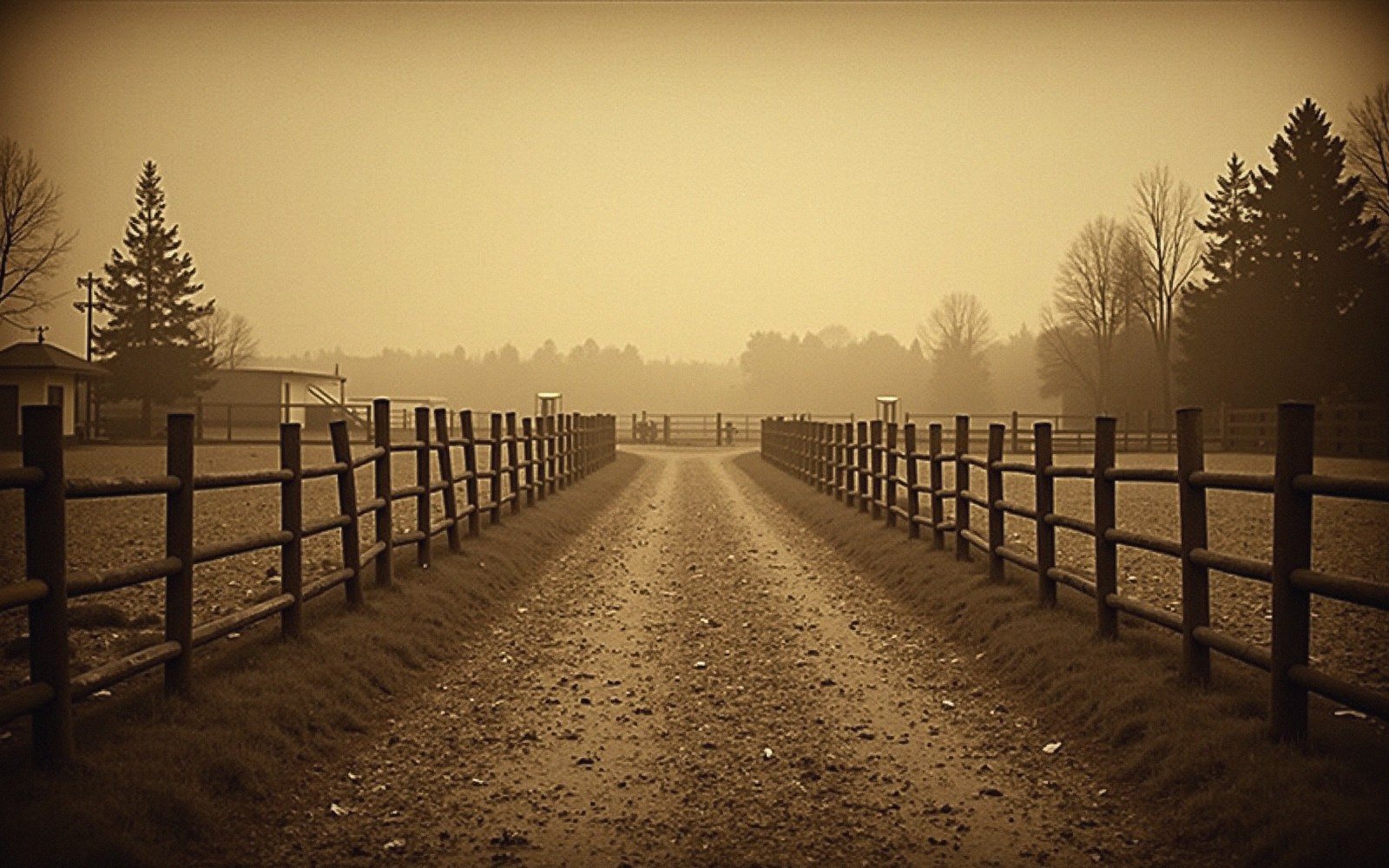
Courses got lighter, tighter and more technical — and riding changed to match.
The earliest show jumping courses looked nothing like what fills an arena today. Fences were solid — walls, gates, timber oxersOxerA spread fence with two sets of rails, asking for width as well as height. — and the ground between them was largely an afterthought. Riders cantered a loose, forward line, and the horse's boldness and scope did most of the work. Getting around was the question. Getting around fast and clean, fence by fence, was barely the sport yet.
What compressed it was a gradual tightening on every dimension at once. Fences grew lighter and knockable, which put accuracy ahead of bravado. Arenas shrank — particularly indoors — which forced sharper turns between elements. And scoring rules, refined across the twentieth century, made each rail and each second count with increasing precision. The open gallop gave way to adjustable, collected riding where the approach to every fence began well before the previous one was behind you.
The open gallop gave way to adjustable, collected riding where the approach to every fence began well before the previous one was behind you.
Track design followed, and then accelerated, the change. As course builders learned what lighter, more adjustable courses could ask, they introduced related distances, in which the stridesOne full canter step, roughly 3.5 m in a working competition canter. between them are counted.related distancesmeasured ground between fences that dictates the number of stridesrelated distancesmeasured ground between fences that dictates the number of strides, combination fencescombination fencetwo or more fences jumped in direct sequence with one or two strides betweencombination fencetwo or more fences jumped in direct sequence with one or two strides between and angled lines that punished any failure to think several strides ahead. A horse might now meet a verticalVerticalA single plane of rails with no spread — a pure height and accuracy question. on a sharp turn out of a double, at a height where half a step of error brings the rail down. The rider has to produce exactly the right canter at exactly the right moment — scope alone will not save a bad stride.
The physical demands on the horse did not disappear; they redistributed. A modern top-level round requires quick changes of balance, the ability to shorten and lengthen within the same canter, and sharp responsiveness to subtle aids. What the sport stopped rewarding was raw speed across the ground and sheer jumping power deployed without precision.
The result is a discipline that looks, from the stands, almost geometrically exact — riders threading turns, horses snapping rails clean by centimetres. That neatness is not incidental. It is the direct product of a century of course design becoming steadily smarter, asking questions that only a genuinely well-schooled partnership can answer.1
- Early erasolid, fixed obstacles; forward riding; boldness rewarded over precision
- Mid-20th centuryarenas formalized, knockable rails standardized, scoring tightened
- Late 20th century onwardcombination fences, related distances and angled lines become standard design tools
- related distances
- measured ground between fences that dictates the number of strides
- combination fence
- two or more fences jumped in direct sequence with one or two strides between
- collected canter
- shortened, balanced canter with increased engagement of the hindquarters
Every figure in this guide is indicative. Heights, spreads, speeds and distances vary between levels and federations, and the rules of the competition being run always govern.
- Early courses rewarded boldness; modern ones reward adjustability. ↩
- Related distances turned course design into a written question.