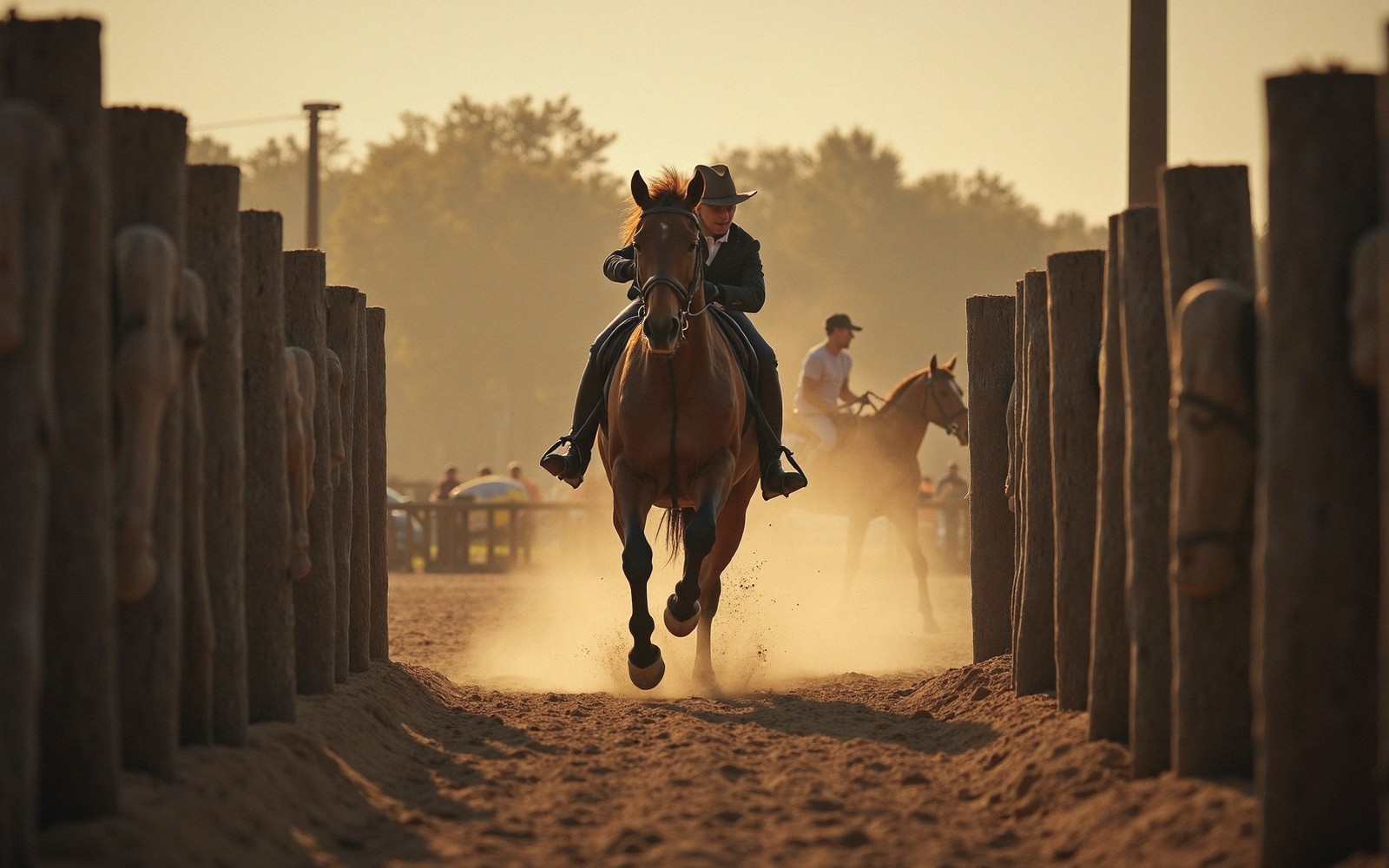
A clear roundClear roundA round completed with no jumping faults and inside the time allowed. — no rails, no refusals, inside the time allowed — is what every rider aims for in the first round of a competition. At the end of the class, though, there are often several of them. That problem requires a solution: the jump-offjump-offa shorter, timed second round for riders tied on zero faults.
The jump-off is a second round, contested only by the riders who finished the first round without jumping faults. It is shorter than the original course, faster in intent, and decided first by faults and then, among those who go clear again, by the clock. The rider with zero faults and the lowest time wins. Simple in principle; brutal in practice.1
A Different Course, A Different Sport
The jump-off course is not the original track rerun at speed. The course designer selects a subset of fences from the first round — typically seven to ten obstacles — and maps a new track through them. Some fences are combined into new related distancesRelated distanceTwo fences close enough that the stridesStrideOne full canter step, roughly 3.5 m in a working competition canter. between them are counted. between them are counted. between them are counted.; some are approached from a different angle. The result is a condensed, angular course that rewards boldness, tight turns and an ability to read distance at pace.
The result is a condensed, angular course that rewards boldness, tight turns and an ability to read distance at pace.
Because the track is shorter, riders must make up time through the air and on the ground between fences, not over a long galloping stretch. Every unnecessary stride costs fractions of a second, and fractions win classes. The first rider to go in the jump-off sets the time to beat; every subsequent competitor knows exactly what they need to do.
This is the point at which the sport becomes openly tactical. Riders in later positions have the significant advantage of knowing what time they must beat. The rider who goes first — often chosen by draw — must commit to a time without knowing whether it will be fast enough. Going too conservative risks being overtaken; going too aggressive risks a rail or a stop that puts them out of contention entirely. A four-fault jump-off round is rarely placed.2
Turns, Risk and the Time Advantage
The most visible difference in a jump-off, for spectators and riders alike, is the turning. Where a first round flows along a designed track with natural distances and planned approaches, a jump-off rider will cut inside a wing, spin off a landing, or approach a fence at an angle that would look reckless in a normal round. These decisions are not reckless — they are calculated. An inside turn that saves two strides can shave nearly a second off a time, and at the top of the sport, classes are regularly won and lost by tenths.
Fence selection matters too. Oxers on the jump-off course demand respect: they are wide as well as tall, and the spread penalises a horse that arrives short or chips in an extra half-stride. A verticalverticala fence with all elements in a single vertical plane; no spread near the end of the course, taken at pace with a sharp turn, can roll if the horse meets it wrong. Riders must balance the aggression that speed demands against the accuracy that keeps the rails in their cups.
- jump-off
- a shorter, timed second round for riders tied on zero faults
- time allowed
- the maximum permitted time for a round, beyond which time faults accrue
- oxer
- a spread fence with two sets of rails, requiring width as well as height
- vertical
- a fence with all elements in a single vertical plane; no spread
What It Looks Like From the Stands
If you are watching a class for the first time, the jump-off is the moment the atmosphere changes. The first round tends to be methodical; the jump-off has an urgency to it. Riders come in with purpose, cut corners, and the crowd begins to understand that they are watching a head-to-head sprint as much as a test of jumping ability.
The scoreboard matters here. Keep an eye on the time displayed after each round: the leader's time is the benchmark, and every competitor after them is either chasing it or defending against it. When a rider comes through the final beam fractionally inside the current leader, the jump-off has done exactly what it was designed to do — reduce a field of equals to a single winner, by the narrowest margin the sport can measure.
The course designer
Licensed official
Plans the track before anyone rides it: fence types, distances, angles and the time allowed. Oversees the build and adjusts for ground and light.
A role on every show, described here without naming individuals.
The fence crew
Arena team
Resets rails between rounds, checks cups and safety devices, and keeps every round on the same track as the one before it.
Role, not a named person.
Every figure in this guide is indicative. Heights, spreads, speeds and distances vary between levels and federations, and the rules of the competition being run always govern.