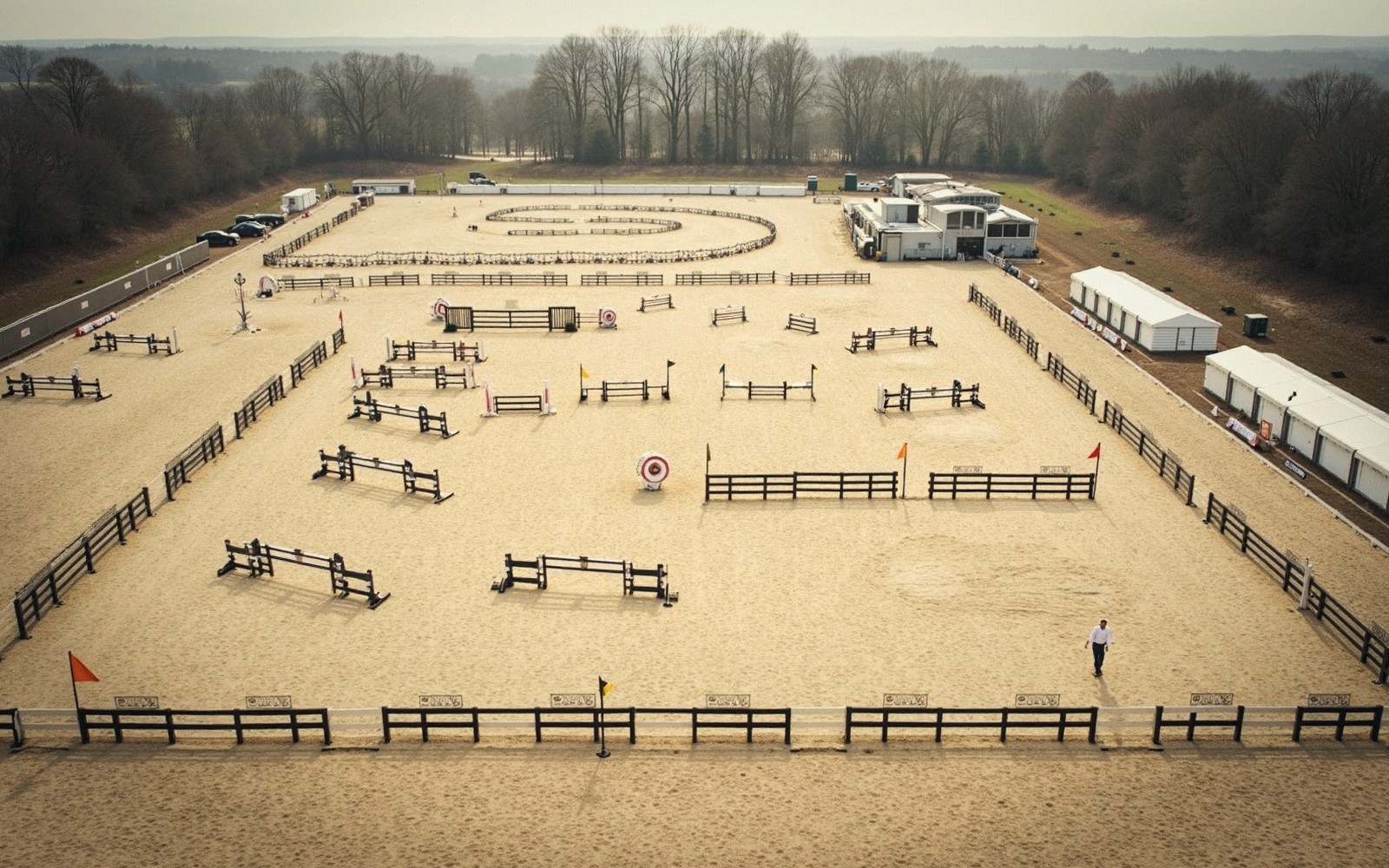
Every fence on a course plan is the answer to a question the designer asked before it was built.
A course map looks, at first glance, like coloured rectangles scattered across a rectangle. Watch a round, though, and the scatter resolves into grammar: each fence is positioned to create a specific problem, and its position relative to every other fence is precisely what makes that problem hard or easy to solve.
The first question any designer answers is where the horse will be when it arrives. Not just the physical spot on the ground, but the horse's balance, its speed, the angle of its approach and the distance it has travelled since the last effort. A fence set after a sweeping, galloping turn invites energy; the same fence reached off a tight, collected bend asks for something quieter and more careful. Height matters far less than context. A 1.30-metre verticalVerticalA single plane of rails with no spread — a pure height and accuracy question. at the end of a long diagonal is a different object from a 1.30-metre vertical tucked into a combinationcombinationtwo or three fences numbered as one obstacle, with one or two stridesStrideOne full canter step, roughly 3.5 m in a working competition canter. between between between after two strides of compressed canter.
The first question any designer answers is where the horse will be when it arrives.
Corners and turns are the designer's first tool. Placing a fence so that the ideal approach line is also the line that requires the most precision — a slight angle, a fraction of extra distance, a bend that arrives at the wrong moment — is how a straightforward obstacle becomes a genuine test. A fence placed immediately after a turn forces the rider to shorten the approach without sacrificing impulsionimpulsionthe horse's stored, elastic energy, distinct from raw speed; a fence immediately before one forces a decision about speed while the horse is still in the air.1
The opener
An opener exists to settle the round. It is deliberately soft so the horse reads the light and the footing before the track starts asking questions.
Straight off the left rein, met out of a forward canter with nothing asked of it.
The first true question
The first width of the round, set on a related distance — it checks whether the canter you opened with is genuinely rideable.
Five forward strides on a straight line, so the stride you land on is the stride you jump from.
The turn fence
Placed just after the turn so the horse sees it late. It punishes riders who let the shoulder drift through the corner.
Off a right-handed turn, arriving on an angle unless the rider straightens early.
The ascending spread
The widest effort on the track. It needs genuine gallop, which sets up the trap of arriving too big at the combination that follows.
Ridden forward off a long approach down the top of the arena.
Combination, in
A related distance sets the trap: ride seven and arrive close, add an eighth and arrive weak. The whole combination turns on this decision.
Seven strides from the triple bar, on a dead-straight line along the top rail.
Combination, out
A one-stride to a width is the classic accuracy test: too big at the in, and the horse has nowhere to put the front end at the out.
One stride out of 5A — no room to adjust, so the answer was given on the approach.
The water tray
Water under a rail changes nothing physically and everything mentally. Horses back off the shine, so this fence tests the leg, not the eye.
Down the left side, off a soft left turn with the tray on the landing side.
The wall
A solid-looking face this late in the round asks a tiring horse to keep its shape. Blocks fall easily; the fence is less severe than it looks.
Across the middle of the arena on the left rein, met square.
The last width
The biggest oxer of the round placed where the horse is tiring. Riders who saved the canter here jump it; riders who spent it early do not.
Four strides on from the wall, and the last chance to make up ground before the turn home.
The last
A plain vertical at the end of a long track. Nothing technical is left — it simply asks whether the horse is still rideable and straight.
Off a right turn to the finish beam, with the crowd behind it.
Flow, Disruption and the Whole-Course Arc
Good design has rhythm and disruption in calculated proportion. An opening run of fences typically flows — turns are generous, distances are comfortable, the horse finds its stride. This is not generosity; it is scaffolding. The rider settles, the horse relaxes, and confidence builds — which makes the disruption, when it arrives, land harder. A broken linebroken linea multi-fence line set on a slight angle, not perfectly straight or an abrupt change of rein mid-course unsettles a horse that has just learned to relax into the arena's pace.
The placing of the related distances — lines of two, three or more fences where the ground between them locks the horse into a rhythm — is perhaps the most deliberate decision on the whole plan. Too generous and the related distance rides itself; too tight and it becomes a trap rather than a test. The designer calibrates these distances to a canter stride length that is neither the longest nor the shortest a top horse will produce, which means every rider must make a choice about whether to add, leave out or simply manage.
Late fences carry disproportionate weight. A horse that has jumped twelve obstacles is physiologically and mentally different from the horse that left the start. Designers know this, and they exploit it: a skinny vertical or a water ditch placed at fence thirteen asks a tiring horse and a concentrating rider to produce precision exactly when both are closest to their limits. That is not cruelty; it is the point. Championship courses, in particular, are built so that the hardest question arrives when the most is at stake.
Read the course plan — most shows post it near the collecting ring — before the class begins, and the fences stop being decoration. Each coloured rectangle sits where it sits because a designer looked at blank ground, imagined a horse travelling at speed, and chose that spot to ask a particular question. Every fence is already an answer.2
- related distance
- a line of fences set close enough that stride count between them is fixed
- broken line
- a multi-fence line set on a slight angle, not perfectly straight
- impulsion
- the horse's stored, elastic energy, distinct from raw speed
- combination
- two or three fences numbered as one obstacle, with one or two strides between
Every figure in this guide is indicative. Heights, spreads, speeds and distances vary between levels and federations, and the rules of the competition being run always govern.